Monday, December 31, 2012

Why Did The Yankees Finish 13.5 Games Behind The A's In 1931?

The A's were 107-45 for a .704 pct while the Yankees were 94-59 for a .614 pct. The A's outscored their opponents 858-626 (good for a 97-55 Pythagorean W-L record) while the Yankees outscored their opponents 1067-760 (good for a 100-53 Pythagorean W-L record). All data comes from Retrosheet and Baseball Reference.

The A's were 19-14 in 1run games while the Yankees were 19-20. The Yankees were 44-9 in games decided by 5+ runs, a .830 pct. The A's were 31-14 in games decided by 5+ runs, a .689 pct. So it looks like the A's were not especially great in close games or in lopsided games, while the Yanks did poorly in close games and great in lopsided games.

The A's and Yankees were also about even in their differentials in AVG, OBP and SLG. The following table shows this.


The A's had a batting average differential that was just .001 better. They were slightly better in SLG differential but that is offset by the Yankees having a better OBP differential. It seems like they should have had very similar records.

Maybe it was something else. Maybe the A's had better baserunning or reached on errors (ROE) alot more than their opponents. No, that is not the case, either, as the next table shows (the little i means Retrosheet does not have complete data on something).


Neither team had an especially big advantage in ROE or GDP, based on what is available. But the Yankees seemed to do alot better in stealing. The SB and CS for their opponents is about the same for both the Yankees and A's. But the Yankees stole alot more bases with a much better pct. So there is still no statistical smoking gun.

But the A's came through in the clutch alot more as the next couple of tables will show. RISP means withe runners in scoring position (Retrosheet notes that they don't have complete numbers on these splits).


It may be hard to take all that in, so the next table shows the differential for each team. But notice how well the A's hit with men on, with RISP and when it was Close & Late. Just incredible. The Yankees did not hit especially well when it was  Close & Late.


The advantages the A's have when it was  Close & Late are just astounding. They outslugged their opponents by .175. The Yankees, meanwhile, seemed, at best, to break even with their opponents when it was  Close & Late. Maybe this is the key to the 13.5 game margin.

The Yankees and A's split their 22 games at 11 wins each. But the Yanks outscored them 124-97, which should have given them 13.6 wins or a .620 pct.

The A's won 7 games by 1 or 2 runs while the Yanks won 4. The Yanks won 3 games by margins of 11, 12 and 12 runs while the A's won only one game by 10 + runs (12).

At the end of August, the Yankees were 17.5 games behind (actually in 3rd place-the Senators were in 2nd, 15.5 games out). They had  a Pythagorean W-L pct. of 0.625. The A's had about .670. The Yankees would have been about 5 games out, still with a chance to win the pennant. But they only had 3 more games left against the A's.

The Yankees actually went 21-6 after Aug. 31, outscoring their opponents 198-87. The A's were just 17-10, outscoring their opponents 137-120. They really had no need to try very hard that last month. So some of the mystery is solved with the September performance. But still, going into that month, the Yankees should not have been that far behind. The A's performance in the clutch is what gave them the big edge. This is probably due to luck.

Update Jan. 2: Although the A's had a better Pythagorean W-L pct. through August, it is still possible that the Yankees "out played" them. I don't have the OPS differential for each team through August, but I can show something similar based on each team's HRs, nonHRs and BBs and what they allowed in those stats.

I have previsously run regressions with the differentials of those stats on a per game basis to explain a team's winning pct. Here are the differentials each team had per game through August:

A's: 0.341, 1.22, 0.444
Yanks: 0.496, 0.512, 1.094

Here is the regression equation for the 1930s that I came up with

Pct = 0.496 + 0.145*HR + 0.035*NONHR + 0.025*BB

Now those are all differentials. If you plug in the values for the A's, you get .599. So they were a very good team through Aug. But the Yankees were better, at .613. So even before Sept, when the A's were able to coast, they still must have been timing things better than the Yankees, being 17.5 games ahead of them.

Again, I wish I had the OPS differential for the pre-Sept games. One problem with this lastest analysis is that it does not take into account what the nonHR hits were. It turns out the A's hit more 1Bs, 2Bs and 3Bs than their opponents while the Yankees just had more 1Bs. The Yankees actually had fewer 2Bs and fewer 3Bs.

So I assumed that the breakdown each team had for 1Bs, 2Bs and 3Bs as a percentage of all nonHRs was the same pre-Sept as it was for the whole season (this was done for those hits allowed, too).

Then I found each team's differential for 1Bs, 2Bs and 3Bs as well as HRs and BBs, but for pre-Sept. only. Then I calculated the linear weights value of those differentials. I had the A's being 177 runs better than their opponents while the Yankees were about 150 runs better.

So that makes the A's a better team pre-Sept. But those 27 runs are worth only about 2.7 wins. It should have been a close pennant race up to that time. So, again, it was pretty lucky for the A's that they had such great timing in getting or preventing hits.

Thursday, December 20, 2012

1974: The Year The MVP Voting Went To Heck

This is a family blog, so I have to say heck.

After checking data at Baseball Reference, 1974 looks like the first year that none of the top 3 vote getters in either league were among the top 10 in WAR. I did not find this happening in any year before, even if in only one league (if I missed one, let me know). At least one of the top 3 vote getters was in the top 10 of position players or pitchers in all previous years.

Here are the top 3 in each league from that year:

NL
Garvey
Brock
Mike Marshall (not in the top 10 for pitchers)

AL
Burroughs
Rudi
Bando

Now this is not a systematic analysis. Maybe other years were worse in terms of how well WAR was correlated with the points each guy got.

There were 3 times I found where the winner was not in the top 10 in WAR, but at least one of the other top 3 guys was

Frisch 1931
Cochrane 1934
Powell 1970 (Oliva was 2nd in voting and was in the top 10 in WAR but Killebrew (3rd) was not)

There were some cases of a winner tying for 10th (Boyer, Campanella). Konstanty was 7th among pitchers in 1950, but not in the overall top 10 (which combined pitchers and position players).

Now Frisch and Cochane were also managers. Maybe that influenced the voters.

In 1974, Reggie Jackson, Gene Tenace and Bert Campaneris all had more WAR than teammates Rudi & Bando.

In the NL, Garvey led his team in RBIs and batted over .300.  His teammate, Jimmy Wynn, beat him in WAR, 7.6 to 4.3. But Garvey beat him in AVG (.312-.271) and RBIs (111-108).

Brock set the then SB record with 118. Maury Wills won the award in 1962 when he set a record with 104, so I guess the voters thought Brock had to get some consideration. But Garvey's Dodgers won their division while Brock's Cardinals did not.

Mike Marshall set a record for games pitched with 106 and won the Cy Young award while pitching for the Dodgers.

Jeff Burroughs led the AL in RBIs with 118 (while also batting .301). But his Rangers did not win their division. Only one other player, Bando, had 100+ RBIs in the AL (he had 103).

Here is something I found about that year's MVP vote from the following site

http://www.mrpopculture.com/files/November%208,%201974.pdf
"Lou Brock, who finished second to Steve Garvey in the National League MVP voting, says he wouldn't accept the MVP next year if he stole a thousand bases. Brock, who had his best year ever, expected to get the award and even set-up a press conference. Brock beat Maury Wills' 12-year old record of 104 steals."
I found a NY Times article through my school's library that confirms the 1000 base quote and this is how I recall it. Brock also said the voters used "bad judgement" and his manager, Schoendienst, agreed.

Click here to see the MVP voting for both leagues in 1974

Click here to see the WAR leaders among position players in the NL in 1974

Click here to see the WAR leaders among position pitchers in the NL in 1974

Click here to see the WAR leaders among position players in the AL in 1974

Click here to see the WAR leaders among position pitchers in the AL in 1974

Sunday, November 11, 2012

Verlander For The Cy Young Award?

I don't think you have use too many advanced stats or new formulas to make a case. Steve Kornacki comes up with a new metric to support Verlander. See  Making case for Verlander. (Hat Tip: Baseball Think Factory) But I don't think that is really necessary.

Verlander led the league in IP and strikeouts and was 2nd in ERA to Price (2.56 vs. 2.64). Verlander had 238 IP while Price had 211.

He was 2nd to Weaver in WHIP (1.018 vs. 1.057).

He was 2nd to Weaver in hits per 9 IP (7.012 vs. 7.25). Price was 4th, Sabathia was not in the top 10.

He was 2nd to Sabathia strikeout-to-walk ratio (4.477 vs. 3.983). Price is not in the top 10. Weaver is not in the top 10.

He was 5th in HRs per 9 IP. Price is 4th. Sabathia is not in the top 10. Weaver is not in the top 10.

He was 3rd in strikeouts per 9 IP. Sabathia was 6th and Price was Price was 8th.  Weaver is not in the top 10.

A reasonable objection to Verlander is that he might have been helped by his fielders. But look at how well he did in HR per 9 IP, strikeouts per 9 IP, and strikeout-to-walk ratio. So he did very well in "fielding independent" stats.

Now Verlander did not make the top 10 in walks per 9 IP (he had 2.3). Sabathia (4th, 1.98) and Weaver (7th, 2.147) did. But he beats both of them by a wide margin in IP. Weaver had 188 and Sabathia had 200.

His park could have helped him. But here is where one of the simpler sabermetric stats comes in handy. ERA+, which takes into account park effects and the league average. Verlaner led the league with 160 (meaning he was 60% better than the league average). Price was 2nd with 149. So a very solid lead for Verlander. Weaver had 134 and Sabathia had 124.

His teammate Scherzer led the league in strikeouts per 9 IP. But Scherzer did not make the top 10 in IP, HR per 9 IP, or ERA+ and was just 5th in strikeout-to-walk ratio.

Darvish finished 2nd in strikeouts per 9 IP, ahed of Verlander (who was 3rd, recall). But he only pitched 191 innings and did not make the top 10 in ERA+ or strikeout-to-walk ratio.

I have not mentioned Peavy, Sale, Harrison or Kuroda. But I think Verlander would also compare very well to those guys. Verlander seems to more consistently rank high in meaningful stats than all the rest. So he would be a great choice.


Sunday, November 4, 2012

Did Darwin Barney And Brendan Ryan Go Into Fielding Slumps The Last Two Months Of The Season?

As of August 1st, Barney had 3.3 defensive WAR (in 99 games) and Ryan had 3.2 (in 95 games). But Barney finished with a defensive WAR of 3.6, meaning he only got .3 in his last 57 games. Ryan also finished with 3.6, meaning he got .3 in his last 46 games. Does anyone know what happened? Did they make more errors? Did they get to fewer balls? Their pace sure fell off quite a bit. But they both finished tied for the 38th best fielding season ever with 13 other players.

Wednesday, October 31, 2012

Trout's 10.7 WAR Ties 20th Best Season Ever

That is the Baseball Reference ranking. He is tied with Mays (1964) and Ted Williams (1946)

Click here to see their rank for position players.

The only players to ever have a better season were

Ruth
Hornsby
Yastrzemski
Bonds
Gehrig
Ripken
Wagner
Cobb
Mantle
Mays
Morgan
Musial

Per game (he played in 139 and in one game he was just a pinch runner), he had .0770 WAR. That would be 9th best ever. See Mike Trout's WAR Per Game Is Historically One Of The Best (So Far).

He also had, not surpringly, the best rookie season ever. See Does Mike Trout Already Have One Of The Top Ten Rookie Seasons Ever?

To see the top seasons ever in WAR from Fangraphs, go to Best WAR Seasons For Position Players-Fangraphs. (thanks to David Appelman) They give Trout 10.0 and that is tied for 83rd best every. But, recall he only played 139 games. The average games played for the top 30 is 150. If Trout had played that many and had racked up the same rate of WAR per game, he would have had 10.8, good enough for 43rd.

Saturday, October 20, 2012

How Surprising Was Zito's Performance?

He has not pitched well on the road this year or well against righties while the Cards hit very well at home and very well against lefties (more info below on this).

With the Giants down 3-1 in the series, he pitched 7.2 innings with 6 hits, 6 K's, 1 BB (intentional) and zero runs. That gives him a "game score" (a Bill James stat) of 72. Here is how it is calculated

1.Start with 50 points.
2.Add 1 point for each out recorded, so 3 points for every complete inning pitched.
3.Add 2 points for each inning completed after the 4th.
4.Add 1 point for each strikeout.
5.Subtract 2 points for each hit allowed.
6.Subtract 4 points for each earned run allowed.
7.Subtract 2 points for each unearned run allowed.
8.Subtract 1 point for each walk.

In 32 starts during the regular season, he had an average game score of 49.53 (I came up with an average game score of 46.4 in the NL this year, so Zito was not much better than that).

He is not a big game pitcher, either. His start against the Reds in the division series had a game score of 42. His previous 8 playoff starts averaged 55.13. Only 3 were 68 or higher with a high of 79 (way back in 2001).

It is not like he came on at the end of the season, either. His average game score was 51.38 in his last 13 starts with a high of 66 and only 4 60+ games.

He did have 4 starts this year with a game score of 72 or higher. But those were generally against below average hitting teams.

83 vs. Colorado (in Denver). Rockies OPS+ this year as 91
78 vs. Cubs at home. Cubs OPS+ was 85
74 vs. Braves in Atl. Braves OPS+ was 90
72 vs. Dodgers at home. Dodgers OPS+ was 90

(according to Baseball Reference, the NL league average OPS+ was 94, not 100 for some reason).

The Cardinals were tied for 1st in OPS+ this year with 107 (tied with Giants). Zito had an ERA+ this year of 84. He was hurt last year and only pitched 53 innings. In 2010, his ERA+ was 94.

The Cards had an OPS at home of .786  and .731 on the road while the league average was .718. They had .787 vs lefties but .835 vs. lefty starters. Zito allowed an OPS at home of .726 and .796 on the road. It was .823 vs. righties and .559 vs. lefties (the Cards started 5 righties, a switch hitter and 2 lefties).

Now in his career it is .705 vs. righties and .701 vs. lefties, so maybe righties don't especially bother him. But this year he gave up 1 HR per 9 IP, which was the league average. His SO/BB ratio was 1.63, far below the league average of 2.50. I doubt anyone could have expected his performance last night. He is hardly an ace or stopper.

The average game score by a lefty during the regular season against the Cards was 45.8. The highest by a lefty in Busch was 60 (Bumgarner). So Zito was well above both of those.

Only 3 Lefty pitchers during the regular season had a game score of 72 or higher against the Cards (out of 45 starts)

Johan Santana 90

Gio Gonzalez 82

Clayton Kershaw 79

In the Division series, Gio Gonzalez had 55 and 46. I don't think the Nats had any other lefty starters. Bumgarner had 22 in game 1. I think that is all the lefty starts agains the Cards in the playoffs besides Zito. Did I miss any?

Tuesday, October 9, 2012

Giancarlo Stanton's Amazing Power Season

He hit 37 HRs in just 123 games, finishing 2nd to Ryan Braun's 41. Stanton also set the all-time record for most HRs in a season by a Panoramian (yes, all-time!) His SLG was .608 while his AVG was .290. That gives him an isolated power (ISO) of .318, which, as I will show below, is outstanding for a player his age.

But Marlins Park was not a good HR park this year. 113 HRs were hit there (by both teams) while 157 were hit in Marlin road games. So there were only 72% as many road HRs as at home. It is only one year, but that is a low HR park factor.

Stanton's ISO at home was .287 while on the road it was .357. He had 16 HRs at home in 247 ABs while on the road it was 21 in 202 ABs. I can't help wondering how he would do in a fair park. I don't know how symmetric Marlins Park is, so maybe righties were not hurt as much as lefties. But he has a big home/road differential.

The table below shows the top seasons in ISO relative to the league average by players who were 22 or younger who had at least 400 PAs. Williams gets 252 because .329/.130 = 2.52. That gets multiplied by 100


The rest of the top 15 include Bob Horner, Mel Ott, Jimmy Sheckard, Juan Gonzalez and Joe Jackson. So Stanton is in great company.

Stanton is one of just 3 guys to have an ISO of at least .275 in 2 different seasons at age 22 or younger. The next table shows all those seasons.


Other players with season of .250 or higher were Alex Rodriguez, Juan Gonzalez, Hal Trosky, Frank Robinson, Vladimir Guerrero, Bob Horner, Evan Longoria, Darryl Strawberry. Jimmie Foxx, Mel Ott, Joe DiMaggio and Ted Williams each had one more .250+ season to go along with those seen in the table.

Here are all the players who had 2 seasons of 30+ HRs at age 22 or younger

Albert Pujols
Alex Rodriguez
Bob Horner
Eddie Mathews
Frank Robinson
Giancarlo Stanton
Jimmie Foxx
Jose Canseco
Miguel Cabrera
Ted Williams

Sunday, October 7, 2012

Pujols Had Worst September Ever

His AVG-OBP-SLG in Sept were .269-.315-.420. Those numbers are a bit of a surprise and a bit of a disappointment for the Angels given that he was over 1.000 in OPS in July and August and had .977 in June. The table below shows his OPS+ for each month of his career.


At 104, his OPS+ is far below the next lowest ever for Sept (actually Sept/Oct). The next lowest was 143. It also looks like his 3rd lowest monthly OPS+ ever no matter what the month. In 8 of his 11 previous seasons, his Sept OPS+ was higher than what it was for the whole season. His worst differential had been -17 in 2003. Yet this year it was -37. So his Sept performance was very much out of character. Maybe a normal performance would not have helped the Angels as they finished 4 games out of the wild card.

Thursday, October 4, 2012

Trout Vs. Cabrerra: A Conventional Approach

Cabrerra beat Trout in AVG, .330-.326. If Trout had just 3 more hits, he bats .331. I think everyone agrees that Trout was a much better fielder. He probably took away at least 3 more hits than Cabrerra.

Trout had 49 SBs while Cabrerra had 4. How many SBs might a HR be worth? What if we said 7? That gives Trout 7 and Cabrerra .571. So if we had 6.3 HRs to Trouts total of 30. So that gets him to 36. Then Trout robbed 4-5 guys of HRs this year. So that puts him around 40 and very close to Cabrerra.

Cabrerra led the league in RBIs but Trout led in runs. That has to count for something. Trout was 20 ahead of Cabrerra here (yes, Cabrerra beats Trout 139-83 in RBIs)

Cabrerra grounded into 28 DPs to lead the league. His RBI/GDP ratio was 4.96. Trout grounded into just 7 DPs. His ratio was 11.86. When you calculate value, you have to count the good with the bad. Cabrerra's RBIs were costly in terms of GDPs. Not so for Trout. Even by the conventional stats, Trout looks pretty good.

Wednesday, October 3, 2012

Trout Leads League In OPS+ And SBs And Runs

Sort of a triple crown. I found only 5 other players since 1901 who led the league in OPS+ and SBs in the same season

Cobb
Wagner
Henderson
Mays
Stirnweiss

Some of them did it more than once. They all had at least one of those years as the runs scored leader, too. Stirnweiss did it in a war year, 1945. Don't forget that Trout had only 5 CS to go along with his 49 SBs. Probably the best % of any of these guys (although these days the league average is high so I should look into doing it relative to the league average).

I searched this by realizing that 15 SBs was the lowest league leading total and 144 was the lowest OPS+ leader. Then I had the Baseball Reference Play Index call up all the guys who had those numbers as a minimum. There were 383 cases and I scanned for bold black on SBs for the leaders and found these guys.

Trout went 2 for 3 tonight with a HBP while Cabrerra went 0 for 2. Trout led him in OPS+ 169-167 before tonight. Trout did not steal any bases (had 1 CS). Rajai Davis had 1 SB to get to 46. Trout entered the night with a 129-109 lead in runs scored over Cabrerra.

Braun Is 2nd Player With 2 Straight Seasons Of 30+ HRs, 100+ RBIs, 30+SBs And A .300+ AVG

Vladimir Guerrero was the first in 2001-2002. Barry Bonds had 3 such seasons and he is the only other guy to do it more than once.

Sunday, September 30, 2012

Trout Becomes Youngest Ever To Get 30+ HRs & 30+ SBs In A Season

He just hit his 30th HR against the Rangers. Alex Rodriguez was previously the youngest at age 22 (actually a 40-40 season). Trout was 20 as of June 30.

Saturday, September 29, 2012

Torii Hunter May Make The Top 10 in WAR For The First Time At Age 36

He is currently 6th in the AL in WAR. He has never finished in the top 10 before and he is 36 (or was as of June 30). Off the top of my head, I can't think of anyone who might have cracked the top 10 for the 1st time so late in his career. Who else might have done something like this?

He has 5.1 and 10th place has 4.7 (Pujols). So with only 5 games left, it looks like he will make it. His highest WAR before this was 5.0 in 2009.

For ages 36 and older, a WAR of 5.0 or higher has only been reached 47 times. Randy Velarde was 4th in the AL in 1999 with a 6.7 at age 36. It was his only top 10 finish ever. I think his next best year was 3.2.

Al Oliver made it for the first time in 1982 at age 35. He was 10th in the NL with 5.7.

Chipper Jones Is In A League All By Himself

He is the only player with a career AVG of at least .300, 1000+ XBH, 1500+ BBs, 150+ SBs and 1500+ RBIs (Barry Bonds just missed it with a .298 AVG).

Friday, September 28, 2012

Through 1990, Who Were The Only 3 Players With 1000+ RBIs, 250+ HRs, 250+ SBs and 2500+ Hits?

Answer tomorrow. It was fun for me to discover who they were. Two will seem obvious but the third one might not. I imagine alot of people will go to Baseball Reference or use the Lee Sinins Complete Baseball Encyclopedia. Two are among the all-time greats (one is a household name while the other is among baseball fans, too) while the 3rd was just very good and is probably not a household name and maybe never was.

I did this search because a question came up in the Hornsby chapter of SABR. Who are the only two guys with 1200+ RBIs, 250+ HRs, 300+ SBs and 3000+ Hits?

Answer: Willie Mays, Joe Morgan and Vada Pinson

Thursday, September 27, 2012

Who Was The Most Surprising Triple Crown Winner?

This is similar to a couple of posts that I did last April. See Who Was The Least Likely Triple Crown Winner? and Baseball's Elite, Its Millionaires. In those posts I used all of a player's career stats to determine the rankings (Ruth was the most likely to do it among the guys who never did). Here I looked at each guy who won the triple crown but his rating was based only on what he did before his triple crown season. For Williams and Hornsby, I used their first time (I also only looked at guys since 1900 this time).

A player would get 10 points for each time he led his league in HRs, 9 for a 2nd place, etc. The same was done for AVG and RBIs. So the player had a career total number of points for each stat. A tie for 1st was still worth 10 points. Then those three numbers were multiplied times each other (meaning if a player never finished in the top 10 in one of these stats, his total will be zero).

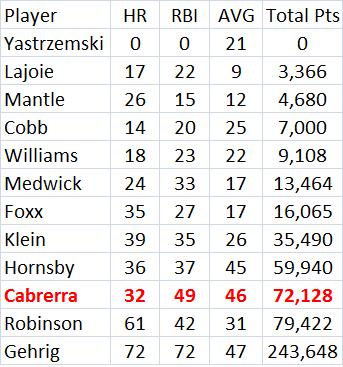
So Yastrzemski was the most surprising. He did not make the top 10 in either HRs or RBIs in his six seasons before he won the triple crown (he was also the least likely to win using career data since 1900). Cabrerra would not be that big of a surprise, especially considering that he has led the league in all three stats in different years already. Gehrig was not a surprise at all he had been in the league leaders for several years in all three stats many times. Maybe his age of 31 made it a little more surprising. But it is not like his career was in decline before that.

Monday, September 17, 2012

Is DeWayne Wise?

Maybe as wise as Fred Merkle. At least the White Sox won't lose a playoff spot or first place finish in this case. Check what happened in the 8th inning today.

Tuesday, September 11, 2012

Chris Sale vs. Stephen Strasburg


BR means Baseball Reference and FG means Fangraphs. I don't know why they are so different on WAR. I also don't know if FIP, xFIP, Sierra and tERA are park adjusted. It looks like BR gives Sale about a 106 for pitching in U.S. Cellular Field and Strasburg does not seem to get adjusted much, so his park must be neutral. So for the league %'s on FIP, xFIP, Sierra and tERA, we could multiply what Sale has by about .94. He would still be higher than Strasburg, but  a little closer.

Sunday, September 9, 2012

Trout's Season Now In Top 50 In WAR

He is at 9.9, tying him for the 47th best season with Ernie Banks (1959) and Rogers Hornsby (1927). Trout bats leadoff and last year in the AL leadoff men got 6-7% more walks + ABs than a cleanup hitter (I guess that most of the great seasons were by 3 and 4 hitters). Should we reduce his offensive WAR by that much to equalize things? I don't know, but even if we did, it would only lower his offensive WAR to 6.862 (I lowered it 6%). But with his defensive WAR of 2.7, it would still leave him with a WAR of 9.5-9.6, tied for no worse than 64th.  If we stick with his WAR of 9.9, the only players to ever have a better season than that who are not in the Hall of Fame are Barry Bonds, Sammy Sosa and Alex Rodriguez.

Update: Through games of Sept. 10, he is at 10.2. That is tied for the 28th best season ever. Fangraphs has him at "only" 8.6. But that is just in 118 games. If he did that for 162 games, it would be 11.8, good enough for the 23rd best season ever at Fangraphs. Over 154 games, it would be 11.2, tied for the 32nd best season ever. Going back to Baseball Reference, if Trout kept up his pace this year for 162 games, he would have 14 WAR, beating Ruth's record of 13.7 in 1923. Over 154 games. Trout would get 13.3 and that would be 2nd to Ruth. If Trout keeps up his current pace over the last 21 games, he will finish with a WAR of about 12. That would tie Hornsby and Yastrzemski for the 4th best season ever. Trout had one game where he pinch ran in the 8th inning and the game ended in the 9th. He had no putouts or PAs or SBs.

Update: Through games of Sept. 11 he is at10.4, tied for the 24th best season ever with Yount (1982) and Bonds (2004). If he can make it to 11.4, he will crack the top 10. Not too easy, since it would be a WAR of about 1.0 in 20 games or 8 for a full season. He is obviously capable of that, of course.

Update:  Through games of Sept. 20 he is at 10.1. Over his last 8 games, he has been .3 below replacement. He was 6 for 30 in those 8 games with just 1 extra-base hit (2B), 5 BBs and 1 SB.

Update: Through games of Sept. 22 he is at 10.4.

Update: Through games of Sept. 26 he is at 10.6. That is tied for 22nd with Ty Cobb (1911) and Rogers Hornsby (1921). Trout has only played 132 games this year. Only 12 players have ever had a season of 10.6 or higher before Trout. They are

Ruth
Bonds
Ripken
Yastrzemski
Wagner
Morgan
Gehrig
Mantle
Hornsby
Musial
Williams
Mays

Update: Through games of Sept. 27 he is back down to 10.5. So he falls to 24th place.

Update: Through games of Sept. 28 he is back down to 10.4 even though he was 2 for 5 with a HR and a 3B. So he falls to a tie for 24th place.

Update: Through games of Sept. 30 he is back up to 10.5. The Angels played a doubleheader on Sept 30 after being rained out the day before.

Update: Through games of Oct. 1 he is up to 10.7. That is tied for 20th with Mays (1964) and Williams (1946)

Wednesday, September 5, 2012

One Possible Key To The Orioles

They are now tied for 1st place with the Yankees yet they have a run differential of -19. Their record is 76-59 and 24-7 in 1-run games. Here is one thing that might be the difference. Their batters have an OPS of .722 while their pitchers have allowed an OPS of .724. That should give them just about a .500 record. But in close and late situations their batters have an OPS of .697 (probably a typical dropoff) but their pitchers allow just a .598 OPS. Maybe that is why they wins so many close games.

In the AL this year the overall batting OPS is .733. In CL situations it is .683. So the Orioles only drop off  .035, not the norm of .050. For AL pitchers, the overall OPS allowed is .729. In CL cases it is .674. So the Oriole drop off is .126 while it is just .055 for the league.

In non-CL situations the Orioles have about a .727 OPS and their pitchers allow a .747 OPS. Here is my formula for predicting winning pct. using non-CL OPS and CL OPS (both for batters and what is allowed)

 PCT = 0.501 + 0.918*NONCLOPS + 0.345*CLOPS - 0.845*OPPNONCLOPS - 0.421*OPPCLOPS

That would give them a .526 Pct. Then they should have 71 wins but they really have 76. So there are still 5 wins not explained.

Baseball Reference gives the Orioles hitters a clutch rating of 2.9, meaning that they tend to hit better the more runners on base, the closer the score and the later the game. So they have won 2.9 more games than you would expect from their hitting than you would normally expect. Pitchers have 6.8. That adds up to 9.7. If they were to win only half their games, it would be 67.5. But if you add 9.8 to that you get 77.3. Very close to their actual win total of 76. They just perform better when it matters more.

Sunday, September 2, 2012

Chipper Jones In Rare Company With 1000+ Extra-base Hits, 1000+ Wallks And A .300+ AVG

The list is below. Only 17 players have dones this and the numbers are only through 2011. Jones still has a .304 lifetime AVG. AROD is down to .301. All 12 of the eligible players on this list are in the Hall of Fame. The non-eligibles are in red. To be on this list you need power, patience and the ability to hit for average.

Tim Lincecum's Numbers Good Since The All-Star Break

IP 60.2
H 56
BB 21
SO 58
HR 6
ERA 3.26

Wednesday, August 29, 2012

Mike Trout's Season Is Now In The Top 100 Of All-Time And It Looks Like It Is Now The Greatest Rookie Season Ever

He now has a WAR of 9.1. Click here to see the leaders. Trout is tied for 94th. Actually 94th-103rd. He also is 2nd only to Babe Ruth's 1923 season in WAR per game (.0858). Click here to see that list. If Trout could get just .0429 WAR per game over the last 33 games, he would add 1.4 WAR. He would finish with 10.5. That would be the 24th highest ever.

Click here to see the rookie list.. I think Joe Jackson has the previous best rookie season at a WAR of 9.0.

Update: Through Aug. 30, Trout has slipped to 8.9 WAR

Update: Through Aug. 31, Trout is up to 9.2 WAR


Tuesday, August 28, 2012

Who Was The Greatest "All-Around" Player Ever? Another Quantitative Attempt (Part 3)

Part 2  is below with a link to part 1. I used four stats: one for fielding, one for speed (based on triples), one for hitting for average and one for hitting for power (ISO). The four stats were multiplied by each other and I calculated their geometric mean. Players had to have 5000+ career PAs. They are relative to the league average and there is a park adjustment.

I have already used both a triples stat and then a SB stat to measure speed. Here I combined them. I used the square root of the SB stat (see earlier posts for how that worked). Then that was added to the triples stat and I simply took the average of the two. One reason I took the square root of the SB stat is that it had a very large range and this brings it more in line with the other stats. This is actually similar to what Bill James does with his "speed score." One of his stats in that involves SBs and he takes the square root of it. He also uses triples. But I don't use fielding range factor, partly because it would be hard to get it for each guy but also I am already using fielding here. I don't uses CS or GIDP since we don't have them for all of history. I don't use runs scored since that depends on your teammates.

So here is the top 25.


Here are the numbers for Mays. Recall that they are relative to the leage average:

Fielding: 1.13
Isolated Power: 1.89
Average: 1.14
Speed: 1.49

Mays got a slight bumb from the park adjustment (an increase of 2%). For the above replacement level version here are the leaders (this was done the same way as in the first two posts). Mays has a solid lead. He has been the best or near the top so far in all the ways I have looked at this.

http://cybermetric.blogspot.com/2012/08/who-was-greatest-all-around-player-ever_23.html

http://cybermetric.blogspot.com/2012/08/who-was-greatest-all-around-player-ever.html

Thursday, August 23, 2012

Who Was The Greatest "All-Around" Player Ever? Another Quantitative Attempt (Part 2)

To see Part 1, go to Who Was The Greatest "All-Around" Player Ever? Another Quantitative Attempt. I used four stats: one for fielding, one for speed (based on triples), one for hitting for average and one for hitting for power (ISO). There was a park adjustment, too. The four stats were multiplied by each other and I calculated their geometric mean. Players had to have 5000+ career PAs.

In this case, I used a stat for stolen bases for speed instead of the one for triples. Because of that, the isolated power stat here was not adjusted for triples like I did the first time. The stolen base stat is SBs divided by number of times reaching first base (singles + walks + HBP). That was then divided by the league average. The next post I do will combine triples and SBs to make a speed stat. I think that neither a SB stat nor a triples stat are good enough by themselves.

So here is the new set of leaders. The 1.57 for Bobby Bonds means that the geometric average of the 4 stats was 1.57. If, for example, he had been 57% better than the league average in each of the 4 stats, his geometric average would have been 1.57. His stats were actually

Fielding: 1.08
Isolated Power: 1.63
Batting Average: 1.03
SBs: 3.41

He was 8% better at fielding. His SB rate was 3.41 times the league average.


Willie Mays once again does extremely well (Bobby Bonds was 23rd before). He was 3rd in the other measure using 3Bs for speed. DiMaggio was first. But here he fell to 449th. His stealing rate was only .37. Rickey Henderson rose from 284th place since he did not have very many triples (he was just about average). So some players moved up or down in the rankings quite a bit. The SB rate had a bigger range than the SB rate (although the correlation between the two rates was about .56). It went from 5.35 down to 0.019. The triple rate ranged from 3.85 down to 0.197.

I also calculated an "above replacement" level value, using the same method as last time. Here is the top 25. I don't think the number has any real meaning or interpretation. This just allows us to take into account longevity and the typical decline in performance that we normally see. Mays was 1st in this one last time. Mays probably would gain on Henderson if I could split fielding into throwing and catching (which I will try to do at some point). Would it be enough to pass Henderson? If so, I think it would strengthen the case for Mays being the greatest all around player ever since he ranks so high using either SBs or 3Bs for speed.

Wednesday, August 22, 2012

Major League Baseball Could See Its 500,000th Error This Season!

According to Baseball Reference, since 1876, there have been 499,590 errors made. So only 410 to go. With 30 teams and about 40 games left for each, there are close to 1200 games left in the season. With a rate of .5-.6 errors per game, there should be around 600 more errors this season and we will pass the 500,000 mark.

There have also been 98,790 hit batters, so that could be passed in a couple of years.

Update: Jose Reyes made the 500,000th error on Sept. 15th. See Marlins' Jose Reyes fumbles way into history with baseball's 500,000th error by Jeff Passan. It also has a video clip.

Does Mike Trout Already Have The 2nd Highest WAR Ever For A Rookie?

I tried to compile a list of the best rookie seasons by WAR from Baseball Reference. See my earlier post from August 1, Does Mike Trout Already Have One Of The Top Ten Rookie Seasons Ever? Trout now has a WAR of 8.6. My list would have him 2nd only to Joe Jackson in 1911 (9.0). With almost 40 games left, it seems like he will pass that. He has gained 2.0 in WAR in the last 19 games.

He leads the 2nd best position player in the league, Robinson Cano, by 3.0 (Cano has 5.6). The last time a position player was 3.0 or more better for a whole season than the 2nd best position player was in 2002 when Barry Bonds had 11.6 and Jeff Kent had 6.9.

Tuesday, August 21, 2012

Is Alexei Ramirez A Good Offensive Player?

That is what the announcer said on ESPN's "Baseball Tonight" last night (it was not one of the ex-player analysts who said this). Here is how Ramirez has done in OPS+ in each year of his career:

2008-104
2009-86
2010-99
2011-94
2012-72

His career OPS+ is 92. His career OBP is .317 and this year it is .282. He is not making up for it with base stealing. He does have 14 SBs with only 5 CS this year. But that is of marginal importance and in his career his SB-CS is 61-32.

Monday, August 20, 2012

Is Mike Trout Only The 6th Player To Have 20+ HRs and 35+ SBs In His First 100 Games Of A Season?

He has 24 HRs and 39 SBs in 99 games so far. I called up all the seasons with 20+ HRs and 35+ SBs using the Lee Sinins "Complete Baseball Encyclopedia." 46 players have done this at least once. Then I went through all of those individual seasons and looked at their monthly & daily splits at Retrosheet & gamelogs at Baseball Reference. Here the only players I think have done this before:

Cesar Cedeno-1974
Joe Morgan-1976
Rickey Henderson-1985, 1990
Eric Davis-1986, 1987
Barry Bonds-1990

Let me know if you think I missed anyone. Trout has a good chance to get 30+ HRs and 50+ SBs. Only two players have ever done that, Barry Bonds and Eric Davis, each once.

Thursday, August 16, 2012

Update On Mike Trout's Historic WAR Per Game

10 games ago, I reported that Trout had a WAR per game of .0859 (he had 7.3 WAR in 85 games). He now has 8.1 WAR in 95 games or .0853 per game. That is still 2nd only to Ruth's .0901 in 1923 (since 1900). Trout has .08 WAR per game over his last 10 games. If a player did that for a whole season, it would still be the 7th best year since 1900. See Mike Trout's WAR Per Game Is Historically One Of The Best (So Far)

Wednesday, August 15, 2012

How Much Will The Loss Of Cabrera Hurt The Giants?

He has had about .043 WAR per game this year (assuming 4.5 PAs per game). So over the next 45 games, it would be 1.94. If Gregor Blanco takes over, he would get .76 WAR (he had been averaging about .017 WAR per game). So that is a loss of 1.18 wins. Of course, this is only based on this year's stats. Blanco was not in the majors last year and as of now, his career WAR per game is .01. Last year Cabrera had .026 WAR per game. It is hard to say what the real talent level of each guy is. But if I use the latter 2 numbers, it will cost the Giants .72 wins. If I average that with the 1.18, we get .95 wins. So still in the range of about one less win.

Thursday, August 9, 2012

Who Was The Greatest "All-Around" Player Ever? Another Quantitative Attempt

Some players are said to have 5 tools: they can hit for average, hit for power, run the bases, catch the ball and throw it. It might seems simple to come up with a rating for this-you could just add, say HRs and SBs. But a player who hits 500 HRs and has 0 SBs has less "all-around" ability than a guy that hits 200 HRs and steals 200 bases. If you added HRs + SBs, the first guy looks better. So I will use a geomtric mean (Dan Levitt and Jim Baker made helpful comments-any mistakes, of course, are due solely to me).

Here is what Wikipedia says about it: "A geometric mean is often used when comparing different items- finding a single "figure of merit" for these items- when each item has multiple properties that have different numeric ranges." In fact, some of the values I will be using will have much larger ranges than others.

Here are the measures I will use:

Fielding: I use FRAA from the Lee Sinins Complete Baseball Encyclopedia (fielding runs above average). Sinins got them from Michael Humphreys' recent book Wizardry. I don't have a way of easily breaking this down into throwing (arm) and catching (glove), but I have something in mind that I will use in a future post. I converted it into a rate relative to the league average (like 1.10 means that you saved 10% more runs than average).

Hitting for Average: I will use average relative to the league average.

Hitting for Power: I will use isolated power relative to the league average.

Speed: I use a player's 3B/(2B + 3B) relative to the league average. This is an idea from Voros McCracken. The idea is that it is a % of the time you hit an extra-base hit that you get a 3B. The faster players will have a higher rate here. It is relative to the league average. Handedness is adjusted for. Triples were taken out of the relative isolated power calculation (for both the player and the league average) since they get used in the speed rating. Actually, for isolated power they were considered doubles. Both the speed and power ratings had ranges far beyond those of fielding and hitting for average.

A park adjustment was also made to each player's overall rating (this was based on hitting only).

The four ratings, each relative to the league average, are multiplied times each other and then I take the 4th root of that number (the geometric mean). I used all players who had 5000+ PAs through 2011. The table below shows the top 25.


Some players are not too surprising while others are. One possible weakness is that some players played long careers and in their later years, the averages and rates were dragged down. So I also tried to create a rating for "all-aroundness" above replacement level. If the average level would be 1.00, then replacement could be .8 (what I used). This might be reasonable because 80% of 81 is about 65 wins, an acceptable replacement level (if we want to go down to say 54 or 52 wins, we could assume that the replacement level pitchers would get you the rest of the way there-remember, these are only position players and their hitting, fielding and running).


So how was this calculated? Mays has 1.385. That minus .8 gets us .585. That is how far above replacement Mays was, qualitatively. To quantifiy this, I assumed a 700 plate appearance levl for a full season. Mays had about 17.85 full seasons. So that times .585 gets us 10.44. He is the leader here.


Alot of all-time greats here. But Steve Finley really jumps out as a surprise.

I hope to post more in the next week or two on some of the assumptions I made and how I came up with some of the measures. Other issues include using SBs instead of 3Bs for speed (Rickey Henderson would rank higher then), using HR% instead of isolated power, how park affects play a role in the 3B/(2B + 3B) rate, the handedness adjustment for that stat, including the ability to get a walk as a "tool" and the earlier mentioned issue of breaking up the fielding rating into throwing and catching (it is possible that someone got a good fielding rating and was not really well balanced, that is, it was all due to their arm or their glove). I also need to explain how I turned FRAA into a rate and how I adjusted for handedness in 3B/(2B + 3B). Same for how I calculated and used the park effect adjustment.

Tuesday, August 7, 2012

Chris Sale vs. Stephen Strasburg


BR means Baseball Reference and FG means Fangraphs. I don't know why they are so different on WAR. I also don't know if FIP, xFIP, Sierra and tERA are park adjusted. It looks like BR gives Sale about a 105 for pitching in U.S. Cellular Field and Strasburg does not seem to get adjusted much, so his park must be neutral. So for the league %'s on FIP, xFIP, Sierra and tERA, we could multiply what Sale has by about .95. He would still be higher than Strasburg, but  a little closer.

Sunday, August 5, 2012

Mike Trout's WAR Per Game Is Historically One Of The Best (So Far)

Through yesterday's game, he had 7.3 WAR in 85 games. I found all the seasons with 7.3 or more WAR from 1901-1912 at Baseball Reference. Then ranked them by WAR per game. Trout is 2nd only to Ruth's 1923 season. Then I found the top 200 seasons in WAR from 1871-1900 and ranked them by WAR per game. The table below shows the top 10 from the two searches.


Thursday, August 2, 2012

Are Darwin Barney And Brendan Ryan Having Historic Fielding Seasons?

At Baseball Reference, Barney (Cubs) has 3.3 defensive WAR while Ryan (Mariners) has 3.2. With about a third of the season left, they are on a pace to get about 4.8-4.9 defensive WAR. Here are the top 4 seasons ever:

1. Terry Turner-5.4-1906
2. Art Fletcher-5.1-1917
3. Mark Belanger-4.9-1975
4. Ozzie Smith-4.7-1989

So far this year, after Barney and Ryan, the next highest defensive WAR belongs to Yunel Escobar of the Blue Jays with 2.2

Wednesday, August 1, 2012

Does Mike Trout Already Have One Of The Top Ten Rookie Seasons Ever?

Using the Baseball Reference Play Index, I found the best seasons for anyone in their 1st, 2nd, 3rd, or 4th seasons. If a player had 130 or more career ABs before a given season, I no longer considered him a rookie (I think that is the rule and I think there is something also about days on the roster but I don't know how to find that). So here are what I think are the top 10 seasons ever for a rookie position player in WAR. Please let me know if you think anyone is missing. Notice how few games Trout has played, so it looks like he could pass Jackson.


MJ Lloyd of HaloHangout has a good post on how Trout compares to other great 20 year old players. See Mike Trout Is In Elite Company. AROD has the highest with 9.2 in 1996. So Trout could break that, too.

Friday, July 20, 2012

Doubles As A Percent Of All Hits Over Time

The graph below shows the numbers for the AL.


Now the NL


The trend has also been to a higher frequency of doubles. See The Fastest Players Since 1900 According to the Triple-to-Double Ratio

Friday, July 13, 2012

Why Are The Red Sox Just a .500 Team If They Have a +47 Run Differential And An OPS Differential of +.039?

They hit well with runners on base but their pitchers do very poorly with runners on base and both the hitters and pitchers do poorly when it is close and late. This post was inspired by what David Pinto wrote at "Baseball Musings." See WPA I Can Use. David's post was based on Tango's post WPA insights which in turn linked to Dave Studeman's article Detailed standings at the all-star break.

Here is what I posted at "Baseball Musings."

"They actually hit well with runners on base and RISP. Here are their BA-OBP-SLG-OPS with

RISP) 0.283 0.359 0.458 0.817
None on) 0.260 0.313 0.425 0.738
ROB) 0.279 0.349 0.463 0.813

Now their overall BA-OBP-SLG-OPS and in close and late situations

Overall) 0.268 0.329 0.441 0.770
CL) 0.241 0.310 0.383 0.693

How can a team which hits so well with runners on base do so poorly when it is close and late? Are they at a platoon disadvantage? Just bad luck?

Now the same thing for their pitchers

RISP) 0.256 0.343 0.432 0.775
None on) 0.265 0.341 0.431 0.772
ROB) 0.251 0.306 0.395 0.701

So it looks like their pitchers do much worse with runners on base.

Now their overall BA-OBP-SLG-OPS and in close and late situations

Overall) 0.257 0.321 0.410 0.731
CL) 0.271 0.335 0.403 0.738

So their pitchers do worse when it is close and late.

Overall, they have an OPS Differential of .039 (.770- .731). But when it is close and late the differential is negative. It is -.045 (.693 – .738)

Wednesday, July 11, 2012

Is "Pitching To Contact" Helping The Nationals?

The Yahoo Sports baseball page has a feature article on this. It says "New alphabet: Fewer K's, more W's for Nats: Washington's emphasis on pitching to contact is paying off in victories." The article then is Nationals pitching coach Steve McCatty believes fewer K's equals more W's, and so far so good by Les Carpenter. I really don't see any statistical evidence offered to support this in the article.

This year the Nationals are 3rd in the NL in strikeouts per 9 IP with 8.3 and they have an ERA of 3.21. Last year they were 15th in the NL in strikeouts per 9 IP 6.5 and they had an ERA of 3.58. So it actually seems like they are striking out more batters and their ERA is lower.

This issue came up in April, 2011. See my post Can "Pitching To Contact" Lead To More Scoring? The Twins were supposedly benefiting from it. I was skeptical. Here is what I wrote:

"To look at this, I calculated the batting average and slugging percentage in the AL in 2010 on contact. For contact, I used AB - K + SF. I assumed that sacrifice hits (bunts) and their attempts rarely end up in strikeouts. So in the AL last year when a plate appearance ended in contact, the AVG was .320 and the SLG was .501.

How many runs per game might this lead to? To approximate this, I used the equation

R/G = 16.04*OBP + 11.595*SLG - 5.52

That comes from regression analysis based on the 2007-2009 seasons.

Last year the AL had a leage OBP of .327 and a league SLG of .407. The equation predicts that would lead to a runs per game of 4.44 (it was actually 4.45). But if we used .320 for OBP and used the .501 for SLG, we get 5.44 runs per game. That seems like a big difference.

I am not sure if this approximation works. It would be quite a different game with no walks and the denominator for OBP and SLG is not the same in each case. But even with that said, I am skeptical that pitching to contact (or not trying to cause batters to miss the pitch) is a good idea."

Jeff Sullivan of "Baseball Nation" has a good take on this. See Being Wrong, With The Nationals' Pitching Coach

Baseball Think Factory has an interesting discussion on this. See Nationals pitching coach Steve McCatty believes fewer K’s equals more W’s, and so far so good

Friday, July 6, 2012

Team OPS Differentials So Far In 2012

We are just about at the half way mark. The table below shows all teams. Their expected winning pct is from my equation .5 + 1.26*OPSDIFF


Tango uses 1.8*OBP + SLG to approximate sOBA. Here are the differntials for that

Wednesday, July 4, 2012

Career Leaders In Game Ending Homers

This was posted to SABR-L on June 24 by David Vincent.

Jim Thome 13
Babe Ruth 12
Jimmie Foxx 12
Stan Musial 12
Mickey Mantle 12
Frank Robinson 12
Tony Perez 11
Dick Allen 10
Reggie Jackson 10
Mike Schmidt 10
Harold Baines 10
Barry Bonds 10
Sammy Sosa 10
David Ortiz 10
Albert Pujols 10

Tuesday, July 3, 2012

Can Brett Lawrie Set A New Single Season Record For Defensive WAR?

About half way through the season, he has a defensive WAR of 3.4. The current record is 5.4 by SS Terry Turner in 1906. The only other season with 5 or higher is 5.1 by Art Fletcher (SS) in 1917.

Click here to see the leaders at Baseball Reference

Update: After the July 3 game, he is up to 3.5. That is tied for the 51st best fielding season ever. If he stays on this pace, he would end up with 7.0, beating the old record by 29.6%. It looks like he had 5 assists and a putout last night. In his career he now has a defensive WAR of 5.1 in just 120 games. The single season record for a 3B man is 4.5 by Brooks Robinson in 1968. It looks like Lawrie is already in the top 10 seasons for 3B men.

"The Book" blog had an interesting discussion of Lawrie's defense in May. Part of it has to do with where he stands when the Blue Jays put on a shift, which can affect hs stats. See Has Brett Lawrie ALREADY saved 14 runs so far this year?

Sale & Strasburg vs. Non-pitchers

The table below shows some key percentages. For the percentages, I divided by PAs (with IBBs and SHs being taken out). I included HBP in walks.


Strasburg has the big edge in SO% while Sale is ahead in HR% and BB%. Now let's say they each face 36 batters in a 9 inning game and we use the values from the fielding independent ERA. At 1.4 runs for a HR, Sale is just about .2 runs better. On walks, at .33 runs for a walk, he is also about .2 runs better. But using about .2 runs for strikeouts, Strasburg is about .41 better. That makes him about .1 better.

Wednesday, June 20, 2012

Do Power Hitters Choke in the Clutch?

It might only look that way. See Clutch, WPA/LI, and the Home Run Bias by Kincaid of 3-D Baseball and HR Bias in Clutch scores, based on Situational Wins (WPA/LI) by Tangotiger.

I posted a comment on Kinkaid's post:

"Very interesting. Thanks for mentioning my research. What I posted at tango's blog I went into more detail on mine. See

Don't Let Your Little Leaguers Grow Up To Be Right-Handed Power Hitters Who Strike Out Alot Because They Might Choke In the Clutch.

I also did something several years ago called "Do Power Hitters Choke in the Clutch?" it is at Do Power Hitters Choke in the Clutch?

A study called “Clutch Hitting: Fact or Fiction?” By Andrew Dolphin suggests that they might. It is at

Clutch Hitting: Fact or Fiction

I also did something similar to what you did here by just comparing WPA to linear weights in my presentation on clutch in 2002 at the Boston SABR convention. I had Bonds doing better in the clutch than his linear weights stats would predict.


"A COMPOSITE CLUTCH HITTING STAT
A STAT THAT TAKES INTO ACCOUNT EVERY PLATE APPEARANCE, NOT JUST CERTAIN SITUATIONS. ONE EXAMPLE IS “GAME STATE VICTORIES” BY RHOIDS SPORTS ANALYSIS

"Game State Victories (GSV) is the number of wins a player contributes to his team by measuring the change in the probability of his team winning the game as a result of his At-Bat. It gives greater weight to hits made when the score is close late in the game than those made when the score difference is large or early in the game."

GSV may be similar to Bennett’s PGP (player game percentage) and the Mills brothers’ Player Win Average.

Results from linear regression
Dependent variable: GSV FOR 2001 (231 players with 300 or more at-bats)

Estimated coefficient values for independent variables (all were statistically significant)

1B = .066
2B = .079
3B = .120
HR = .122
BB = .055
Outs = -.021

R-SQUARED = .819   Intercept = -.79

The .819 means that 81.9% of the variation between hitters in GSV is explained by the 6 independent, nonclutch variables. So 81.9% of the weighted clutch performance is explained by nonclutch performance. At most, 18.1% could be explained by clutch ability.

TABLE 10


Pred = the GSVpredicted by the regression equation:

-0.79+ 0.066*1B + 0.079*2B + 0.12*3B + 0.122*HR + 0.055*BB – 0.021*Outs

Outs are At-bats – Hits. Diff = the difference between actual GSV and predicted GSV

Friday, June 15, 2012

Tom Ruane On "When Winning Streaks Collide"

Fun stuff. Click here to go to it. The Yankees and Nationals both have 6 game streaks and they are about to play each other. Tom shows this is kind of thing is pretty rare.

Tuesday, June 12, 2012

Could Bob Gibson Have Been Better In 1970 Than In 1968?

To look at this I did a regression with ERA as the dependent variable and HRs, BBs, and SOs (all per 9 IP) as the independent variables. The data includes all pitchers from 1960-1974 who qualified fore the ERA title. Here is the equation:

ERA = 2.16 + 1.42*HR + .296*BB - .134*SO

Once I found the ERA predicted by this equation for each pitcher (Pred in the table below), I divided it by the league ERA in the relevant year. That number is called Ratio. The lowest ratio belongs to Gibson in 1970 with .59. Notice that he had more strikeouts per 9 IP in 1970 than in 1968. The walks were a good bit higher but HRs were pretty close. And the league ERA was much higher in 1970 (4.05 vs. 2.98).

My crude Fielding Independent ERA for Gibson in 1968 is 2.10. But for 1970 it is only a little higher at 2.40.

Tuesday, June 5, 2012

Did Bobby Abreu Have Good Numbers In The Clutch?

He was booed last night in Philadelphia. See Why Phils fans shouldn't boo Abreu by LESLIE GUDEL of csnphilly.com. One commenter said "Good numbers, but never in the clutch." Let's look at those numbers even though clutch hitting is no big deal. To see Abreu's career clutch numbers, go to this Baseball Reference page: Career Batting Splits.


He has a higher AVG with RISP and runners on than with no runners on. A higher SLG with runners on than with no runners on. No his AVG in Late & Close situations is lower than overall, but that is true for baseball in general. See my article Did The Increased Use Of Relief Pitching Cause A Decline In Clutch Hitting? Usually, AVG falls by even more than what we see for Abreu (it is actually bigger than the .009 we see since my table does not show his non-Late & Close AVG). Abreu hit .295 in non-Late & Close situations. But hs .011 drop is still not quite as big as normal. And his OBP goes up. Getting on base in Late & Close situations is pretty important.

If you want to be technical, we can take IBBs out of the mix. Then his OBP falls from .395 in non-Late & Close situations (using just AB, H, BB, HBP) to .394 in Late & Close situations. Just staying at the same level is good. It usually falls. See General Clutch Data. Now that only covers 1991-2000, but I think it would be similar over Abreu's career. And just think, the other teams thought he was good enough to intentionally walk alot in Late & Close situations. 3.6% of his Late & Close PAs were IBBs. It was only 1.1% overall. So his IBB rate more than tripled in Late & Close situations. Last year in MLB, it was about 2.34 times higher.

Now someone at that site says you need to look at key games and that he did not come through often enough (no specifics are mentioned, though). But if you look at his splits, you can see his career OPS in Sept/Oct is .895, higher than his overall .877. Seems like he hit well in that month, which is most likely to have key games. Also, his career AVG in post-season games is .284, pretty good considering that you are facing better pitching than normal in cool weather. And I think those are key games.

Now the same guy is saying he batted only .243 in Sept of 2005 when they just missed the playoffs. But he still had a .388 OBP. Besides, one month is hardly enough to say he was not good in the clutch. He also batted .320 in August that year, which probably had some key games. This guy also fails to mention that when Abreu hit .294 in Sept of 2001, the Phillies only finished 2 games behind the Braves. A close race and Abreu hit well.

Monday, June 4, 2012

That 23 Year Old Phenom Pitcher Whose Last Name Starts With S Leads His League In ERA

Yes, Chris Sale of the White Sox leads the AL in ERA (with 2.30). Strasburg is 4th in the NL with 2.35. The table below has some statistical comparisons. FIP ERA and xFIP ERA are from Fangraphs and I have the definitions below. ERA+ is from Baseball Reference.


Strasburg, using Baseball Reference splits, has struck out 27.7% of the non-pitchers he has faced this year. Sale has 26.3%. Very close.

The league average FIP's and xFIPs are not the same in each league. For Sale, his FIP and xFIP as a % of the league average are .624 and .753. Strasburg has .608 and .654. So they are very close, at least in FIP ERA.

I am not sure if Fangraphs takes park effects into account on FIP and xFIP, but the pitching park factors from Baseball Reference for Sale from 2010-2012 are 103-106-105, meaning it scores 3-5% more than average and Strasburg has 99-100-100, meaning it is just about average. So Sale's park hurts him a little more than Strasburg's.

Sale has a big lead in ERA+ which is ERA adjusted for the league averae and park effects at Baseball Reference. It could be due to Sale's lower BABIP. If he had Strasburg's .305, it looks like it would add 9 hits and that, on average, would be about 4.5 runs. That would give Sale an ERA of 2.90 and I think his ERA+ then would be about 150. Then Strasburg would have a big edge.

FIP: Fielding Independent Pitching (FIP) measures what a player’s ERA should have looked like over a given time period, assuming that performance on balls in play and timing were league average.

xFIP: Expected Fielding Independent Pitching (xFIP) is a regressed version of FIP, developed by Dave Studeman from The Hardball Times. It’s calculated in the same way as FIP, except it replaces a pitcher’s home run total with an estimate of how many home runs they should have allowed. This estimate is calculated by taking the league-average home run to fly ball rate (~9-10% depending on the year) and multiplying it by a pitcher’s fly ball rate.

Monday, May 28, 2012

White Sox Score 52 Runs In Last 5 Games, A Major League High This Year

And they won all five games, too. The next highest 5 game total this year is 48, by the Rangers. If anyone knows the all-time record, let me know. The 1950 Red Sox scored 82 runs in a five game stretch (17-12-4-20-29). How did the 4 get in there?

Here the White Sox last five games:

6-0
11-8
9-3
14-7
12-6

Konerko leads MLB in AVG with .399. He also leads the AL in OBP with .476 and is 2nd to Hamilton (.753) in SLG with .681. Konerko leads Hamilton in OPS+ 211-204. Konerko's best year ever in OPS+ was 160 in 2010 and the next highest was 142 ion 2011. So this year is a big jump up for him.

Friday, May 25, 2012

Pete Palmer Has A New Book

Well,  maybe not real new since it came out last September. Tom Tango mentioned this at his blog. It is called Basic Ball: New Approaches for Determining the Greatest Baseball, Football, and Basketball Players of All-Time. Here is the Amazon description:

"Basic Ball is a three-for-one deal. Fans who enjoy the three American Sports - football, baseball and basketball - will love Basic Ball. Pete Palmer, inventor of the on-base percentage stat and winner of the 2010 Ralph Hay Award from the Professional Football Research Association, has combined with Dave Heeren, creator of the TENDEX formula for basketball to give the reader the most effective statistical methods for rating players and teams in these three sports. They introduce new theories and formulas to analyze the players at the basic level. Each sport is covered in a full section and more than a hundred pages of databases that give statistical ratings for baseball's greatest hitters and pitchers; the best NFL players of All-time; and every active and retired NBA and ABA basketball player."

Palmer was doing some pretty advanced linear weights analysis back in the 60s. See Pete Palmer’s All-Time All-Star Team, 1969.

Thursday, May 24, 2012

Tim Lincecum vs. Albert Pujols

Which number do you think is lower: Lincecum's ERA+ or Pujols' OPS+? Lincecum has 57 and Pujols has 68 (100 is average in each case and so this means each guy is performing well below average). Who would have thought this at the beginning of the year? Lincecum might be a victim of bad luck. Here are some key stats each year of his career:


He is doing well in strikeouts and HR prevention. But his hits and walks are high and some of the bad luck might just be the high average on batting average on balls in play, which pitchers don't have as much control over. But he just happens to be pitching poorly with runners in scoring position and with with runners on. That is not true for his whole career. The next table shows this:


This year he has done well with no runners on but in other cases not so well. He has no problem like this over his career and so I think his ERA+ should rise over the season.

Pujols has a career OPS+ of 168 and last year it was 148. So the 68 so far in 2012 is pretty shocking with more than 25% of the games played. He only has a .224 BABIP while his overall AVG is .213. For his career, those numbers are .309 and .325. So it does not look like any bad luck on balls in play.

His line drive % is 20% while for his career it is 21%. So nothing major there. But hit HR/FB rate is 5.3% while it is 15.3% for his career. This year 18% of his flyballs have been in the infield while his career rate is 11%. Maybe he is popping up alot. His GB/FB rate is .70, same as it is for his whole career.

If his HR% this year was the same as it was last year (6.4%), he would have 11 HRs and his AVG would be .253 (assuming it was 7 FB outs turned into HRs). So maybe he is not hitting the ball far enough. If he wants to bat .299 this year (as he did in 2011), he needs to bat .337 the rest of the way (assuming he gets 579 ABs).

Last year his April & May OPS+'s were 112 & 113. This year they have been 61 & 70. To reach an OPS+ of 148 this year (what he had in 2011), he needs an OPS+ of 181 the rest of the way. Last year, his post May OPS+ was 172.

This year his SO/AB rate is .129, just a little higher than his career rate of .112. But his BB/AB rate is only .045 while it is .113 for his careeer (in both cases, intentional walks were taken out). So he is not walking alot and maybe he is swinging at too many pitches.

In his last 9 games or 36 ABs, he has 10 hits, good for a .278 AVG. But if he does that the rest of the way, he ends up hitting just .258. He does have 1 2B and 3 HRs in the last 9 games. So his SLG over this stretch is .556. If he did that the rest of the way he still finishes with just a .487 for all of 2012.

Wednesday, May 2, 2012

How Is That 23 Year Old Phenom Pitcher Doing? You Know, The One Whose Last Name Starts With S?

Oh, you mean Chris Sale of the White Sox. Pretty well. His career stats are in the table below.


Now his being a reliever in 2010-11 helps, since relievers usually have better stats than starters. From 2007-11, relievers had, on average, an ERA that was .037 lower than starters. Sale, a lefty, also has faced left handed batters about 40% of the time. So that helps him. But he is certainly doing well this year as a starter. In 32 IP, he has an ERA of 2.81, with 24 hits allowed and 8 walks, 29 strikeouts and just 2 HRs allowed. If Strasburg had Sale's career stats or stats this year, I doubt anyone would think he was not living up to his potential.

Tuesday, May 1, 2012

Pujols Has His Worst Month Ever In OPS+, By Far

The table below shows his OPS+ for every month of his career. 100 is average and it adjusts for the league average in each month and park effects. Now this April was his worst calender month. It is possible that he had a worse 23 game stretch sometime in his career (he played 23 games in April). But when you look at each individual month, it is hard to see when that would have happened because he would have had to offset an OPS+ of 63 with an extremely high one in the other games.

He could have had an OPS+ of 63 over 23 games in June 2006 and then 177 over the other 7 (no problem for Pujols). That would get us 90. So for Pujols to have had an OPS+ of 63 over some other 23 game stretch is possible. But it seems unlikely if you look at his next worst month, the 110 in July 2001. If he had an OPS+ of 61 in 23 games that month the other 7 would need to be 263.

And I know, I recenlty posted Should The Angels Be Worried About Pujols? (and I basically said no). But his OPS was .668 then (4-18). Now it is .570. His AVG-OBP-SLG are .217-.265-.304. The league averages are .252-.318-.408. He did recover after a slow start last year in the first two months. But at least those were above average. The table shows all months with OPS+ < 120 in red. He has struck out once every 6.57 ABs this year. Last year it was 9.98 and for his career it is 8.91.

Wednesday, April 25, 2012

How Long Can The White Sox Stay With Gordon Beckham?

His AVG is .180, his OBP is .255 and his SLG is .240. He was not the starting 2B man today but he is in now as a pinch runner who just got thrown out at home on a double. The table below shows his hitting since 2009


Now he did actually have positive WAR last year with 1.2. But this year he has negative fielding value from Baseball Projections and Baseball Information Systems. The next table shows his OPS+ for each month of his career


Now a graph of those numbers. He is definitely trending downward.